

Finding open data to reuse

Research data are increasingly openly shared, but reuse of such data is not yet common in all disciplines. Therefore, in the second of this series, we look at how to find open data to (re)use.
At the Leiden University Libraries’ Centre for Digital Scholarship, we give training and advice on, among other things, research data management. In the process, we encourage Leiden researchers to share their data as openly as possible. With the traction of the Open Science movement, the publication of the FAIR principles, and the widespread adoption of these, funders, universities, and publishers increasingly require that research data are published, if possible. Consequently, the number of open datasets has increased considerably. However, (re)use of these open datasets seems to lag behind – although it is tricky to get exact numbers on this (Gregory et al. 2025). While likely reasons include issues like the documentation of datasets being too limited to truly reuse them, a first step is to find such datasets. How to find datasets, then, is the focus of this blog post.
This blog post focuses on reusable research datasets. For reusable text sources (articles, book chapters, etc.) and visual media (images, videos, etc.), see the previous blog post by Tessa de Roo.
Where to find existing research data to (re)use?
There is not one, easy way to find all relevant existing research data in one go, and it is most effective to use a combination of the following:
1: Through publications
Check publications like journal articles and book chapters. Data may have been added as supplementary material. Many journals now also require a data statement on where the related dataset can be found. It is also worth checking out if there are related data papers.
For example: In Stroud et al. 2023, no supplementary information or data statement were available, but a related data article was linked to in the online version of the paper. While the dataset itself was not present in that data article, there was a data availability statement, referring to Zenodo, where the dataset could be found.1 The Zenodo entry contained a link to a GitHub repository where the dataset is also available. The open license allows reuse and the data article in combination with a README files and the inclusion of R scripts and methodological information ensure that there is sufficient information to reuse the dataset.
2: By searching the web
A standard search engine is still most effective here in my experience. If you are using an LLM-based search tool, make sure to also navigate to the original source web page to assess the dataset. Searches often yield only some datasets with many results referring to journal articles and other textual resources, which means back to 1) and to finding the data through these articles.
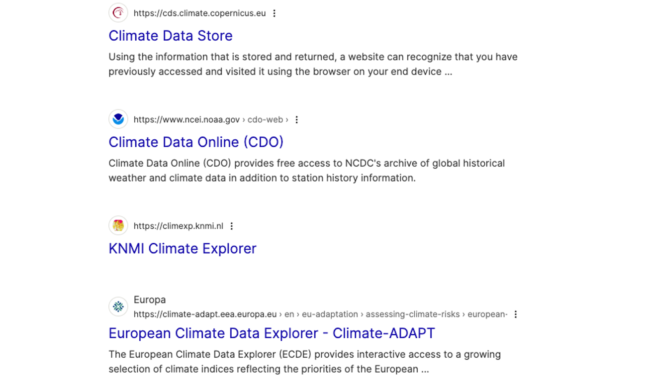
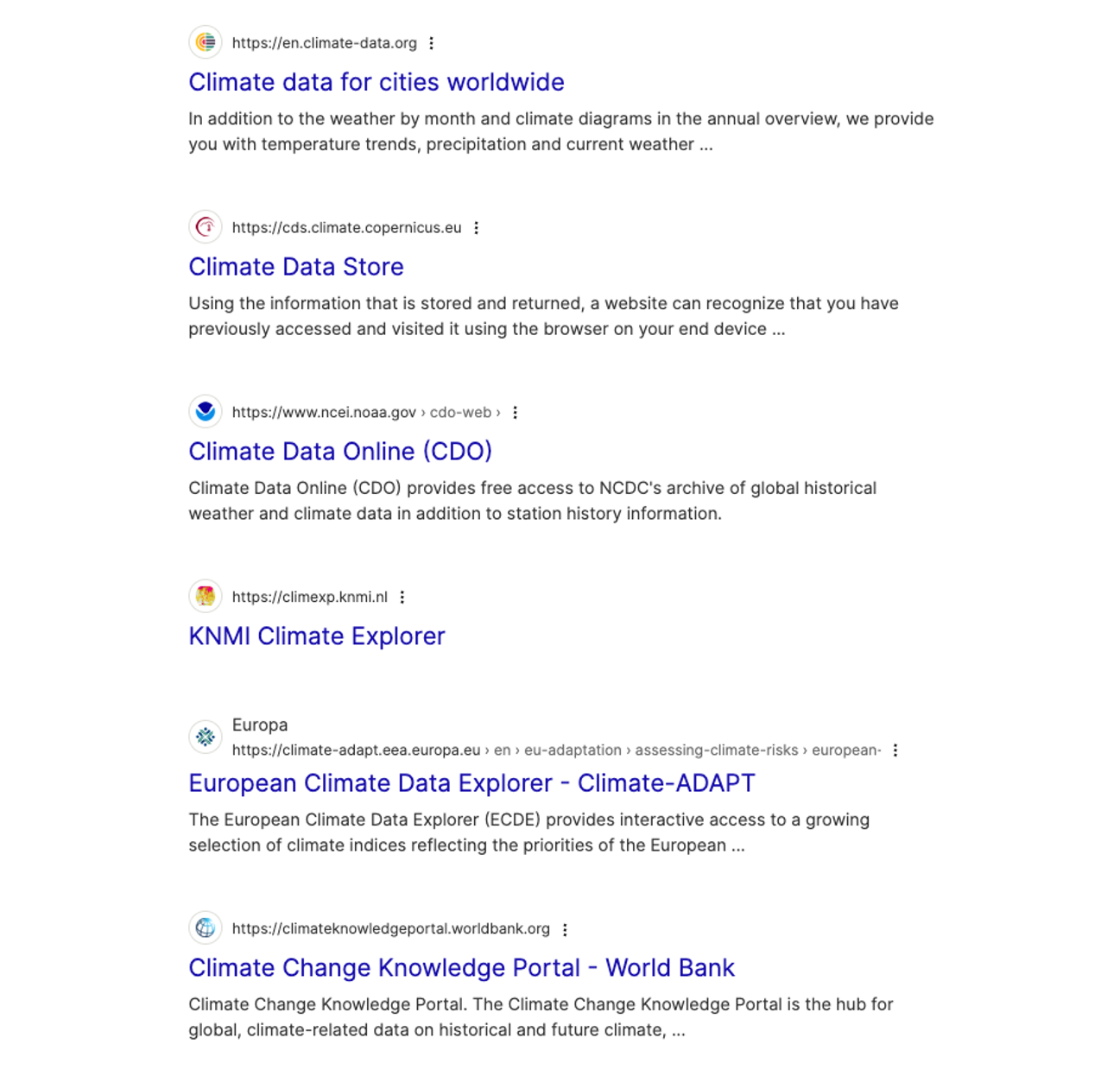
For example: When trying to find datasets on a specific topic (e.g. the effect of charring on plant isotopes, or the environmental impact of LLMs or genAI, or the impact of green spaces of health, to name a few that I tried) the main results were journal articles and other webpages. However, when typing in “find climate data” or even just “climate data” a list of relevant platforms and repositories appeared (Fig. 1) – although no specific individual dataset (see also under 3 and 4). I tried this using Ecosia and Google.
3: Through (meta)data catalogues
Platforms focused on harvesting metadata (information about the data) of research datasets can be a quick way to find these datasets. Generic platforms like Google Dataset Search or the European Open Science Cloud – EU Node – Data can be used. Discipline-specific platforms are more useful, as they have already selected relevant datasets and often include relevant filtering terms. On the other hand, they may not contain information on all relevant datasets.
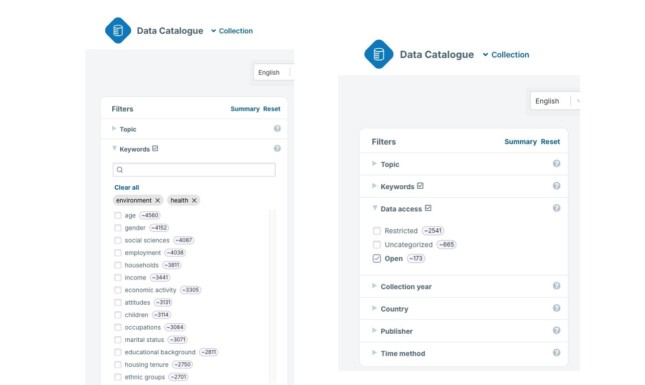
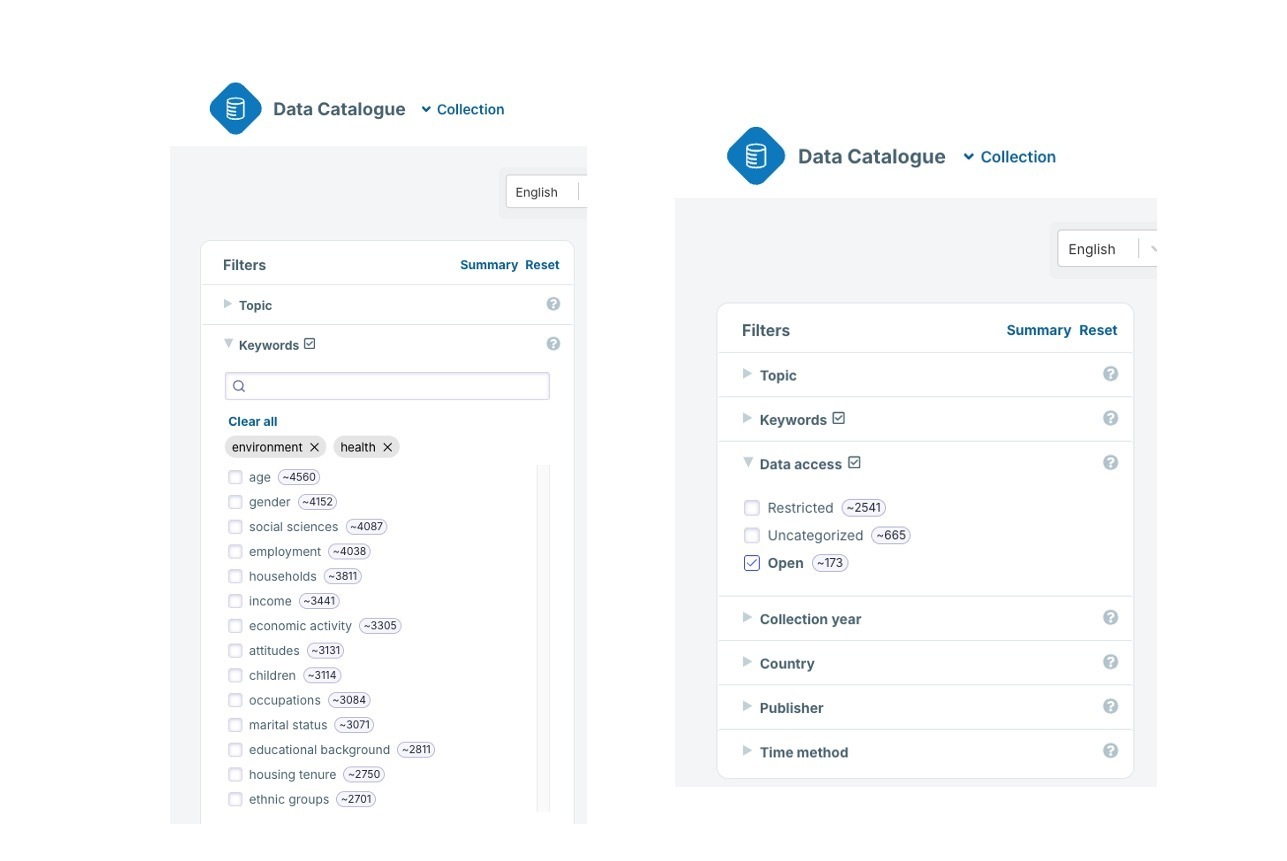
For example: When looking for data on the effect of the environment on health, there are many results in the CESSDA Data Catalogue, such as the Gladwell 2016 dataset in the UK Data Service repository. While the data themselves are not openly available in this case, the summary results and documentation are. In addition, it is useful to know that this study has been done and who to contact to ask for access to the dataset. It is possible to search using free text, but one could also use key words from a controlled vocabulary, such as “health” and “environment”. The filtering options also include filtering for open datasets only (Fig. 2).
Examples of discipline-specific platforms for finding research data:
Archaeology: ARIADNE Portal
Climate and environment:
LifeWatch Metadata Catalogue (biodiversity and ecosystems)
NOAA data platform (environmental observations of oceans, atmosphere, space weather, ecosystems)
ACTRIS data portal (atmospheric data)
EMSO ERIC Data Portal (marine ecosystems)
Life sciences: ELIXIR Data Platform
Linguistics: CLARIN Virtual Language Observatory
Social sciences: CESSDA Data Catalogue
4: By searching directly in a relevant research data repository
If you know of, or find, a relevant research data repository, you can search in there directly. The advantage is that you will find relevant data; the disadvantage is that in this way you may have to repeat the search in multiple repositories.
For example: Looking for archaeological data from Jordan, I checked out several relevant repositories directly. These included discipline-specific repositories and generic repositories often used by archaeologists: the DANS Data Station Archaeology, the Archaeological Data Service, Zenodo, Figshare, Open Context, and tDAR. In this way I found datasets that I had not yet found searching in the above ways (you can see the resulting overview here).
Examples of repositories are the Leiden DataverseNL, the DANS Data Stations, 4TU.ResearchData; Pangaea for earth and environmental science data; the UK Data Service for social science data; Zenodo, and Figshare. You can find other research data repositories, including more discipline-specific ones, at re3data.org.
Find a relevant research data repository5: In relevant databases and on data portals
Many groups of researchers have been compiling data in field-specific databases and data portals. These can be a great resource of relevant, trustworthy data to (re)use in your research. In addition to the above ways, you might find such databases and data portals by looking at which data sources others in your field are using and by asking your peers / supervisors / colleagues and keeping your eyes out for these at conferences.
It is not possible to even come near giving a comprehensive list here, but here are a few examples to give you an idea:
Argo data, global ocean observations
ICOS Data Portal, carbon observations
Survey of Health, Aging and Retirement in Europe (SHARE) database
IsoARCH, archaeological isotopes
Cultural heritage databases, such as the Endangered Archaeology in the Middle East and North Africa (EAMENA) database
Can you reuse the data?
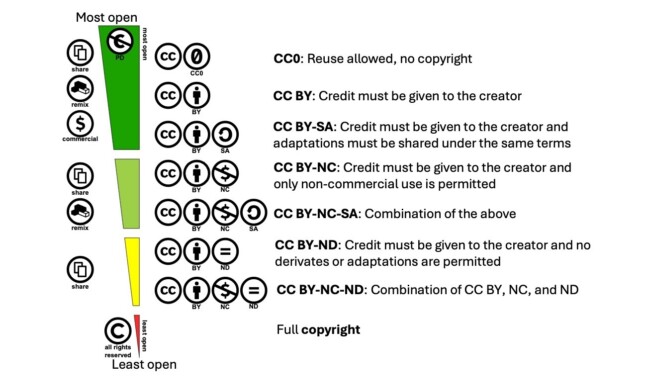
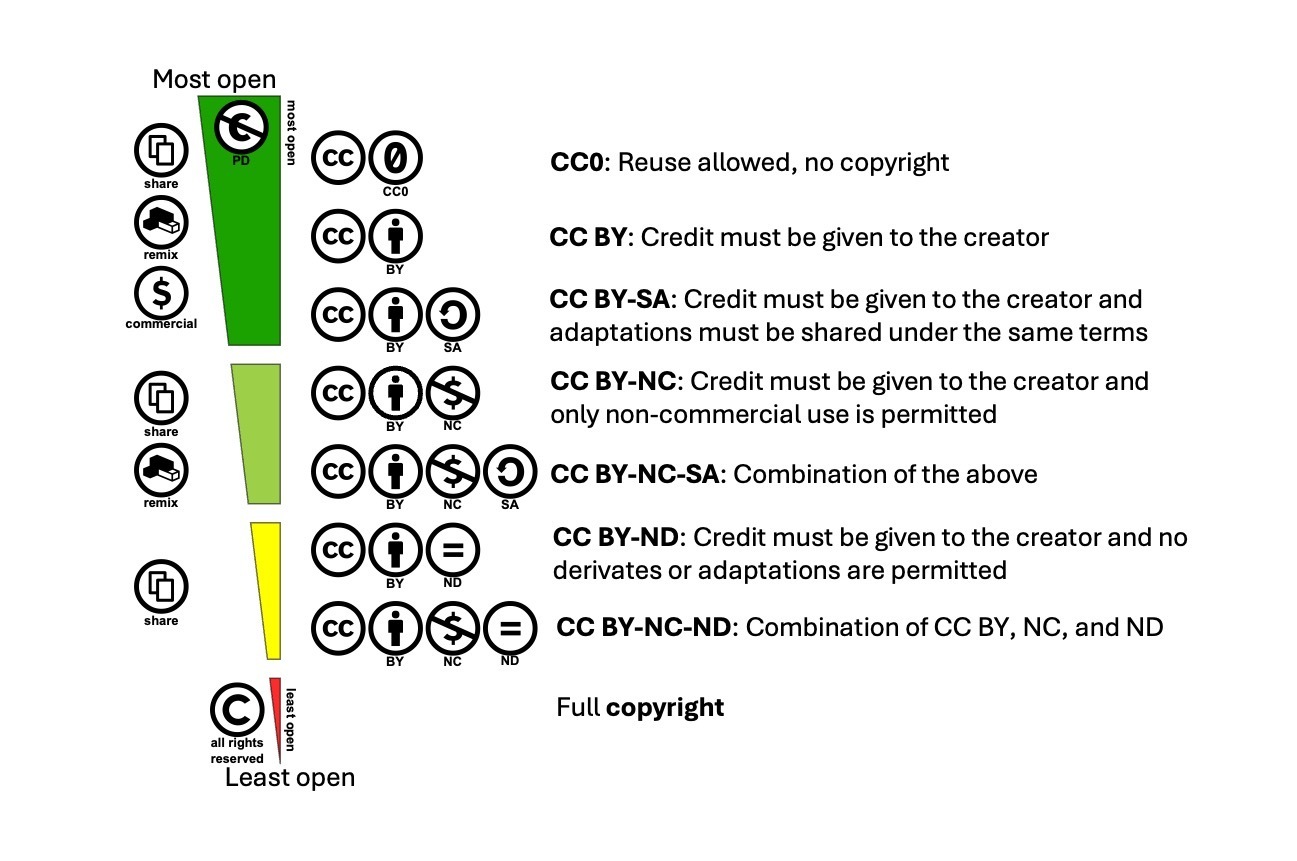
While it is always allowed to cite the dataset you find, whether or not you are allowed to reuse it as part of your compiled research dataset depends on the license or other terms and conditions (Fig. 3). When no license or terms of use are mentioned, you should assume full copyright – in this case you can ask the data ‘owner’ (often either the original data creator, their employer, or the publisher) for guidance and permission. You can find more information on licenses in the first blog of this series.
Notes
- As indeed we would recommend, to publish your dataset separately from the journal paper in a dedicated research data repository (see also this blog on publishing data).
This blog was reviewed by Femmy Admiraal and Fleur Praal. The blog content was created exclusively by humans without the use of generative AI systems (declared under the FAIA framework (faia.io)).