Finding and Reusing Open Materials for Publishing, Presenting, and Teaching

When talking about Open Science, the focus is often on making output openly available. There are many guides on publishing and sharing text, images, and data openly. But to ensure that Open Science is working as it should, it’s important that we know how to find and (re)use open materials, too.
Leiden University Libraries’ Centre for Digital Scholarship (CDS) offers training and advice on almost all areas of Open Science. The CDS can help researchers to share their own work as openly as possible and to use existing open materials effectively and appropriately while respecting any copyright or license restrictions.
If you want to reuse open materials in your work, this blog series is for you.
The Reusability Series
This blog post focuses on reusable text sources (articles, book chapters, etc.) and media (images, videos, audio etc.). For reusable data, code, and other digital resources, head to the next post [coming soon!] in this series.
What is open material?
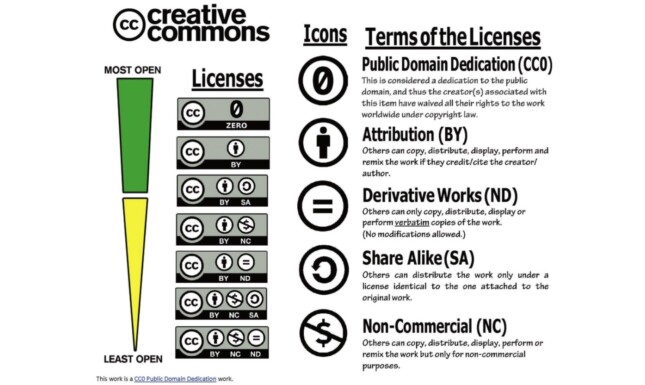
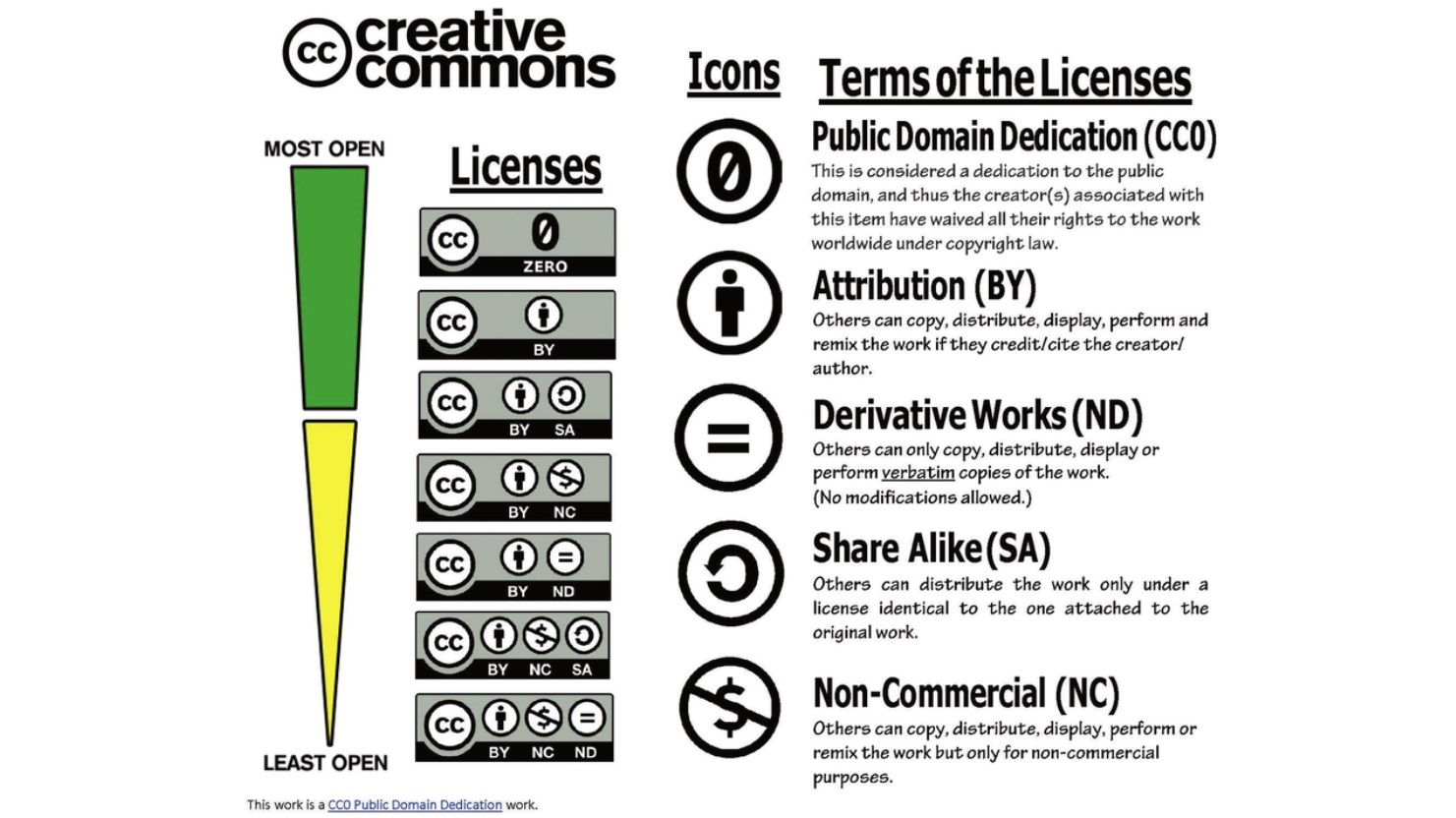
In this blogpost, ‘open materials’ are all digital items (e.g. publications, images, photos, videos) that are either in the public domain or have been published with an open license, most commonly a Creative Commons license (e.g. CC BY). Figure 1 shows the various types of Creative Commons (CC) licenses, ranging from most open to most restrictive. This figure has a CC0 license applied to it, meaning that this image, too, is free to use as it is in the public domain. See the textbox Creative Commons and Copyright below for more information.
Creative Commons and Copyright
For a comprehensive introduction to copyright and legal permissions/restrictions on using published works, check out the national Guide to Creative Commons for Scholarly Publications and Educational Resources.
For further guidance on copyright and re-using materials, visit the CDS Copyright Information Office online resources.
For information on the potential pitfalls of choosing restrictions on CC BY licenses, read the Digital Scholarship@Leiden blogpost Impact on ownership when choosing an NC or ND Creative Commons License.
Most works that have been made public online, such as a journal article, will have a license for reuse clearly stated. If you are not sure if a work has an open license for reuse, you can contact the owner to ask for this or consult the CDS Open Access Team for advice.
In all cases, it is important that you respect the license applied to the work you are reusing (more on this below) and always cite your sources fully. Reusing materials in a way not permitted by a source’s license or republishing copyrighted material without permission can have legal implications for you and the University.
Why reuse open material in your work?
A key advantage of reusing existing open materials is that you do not need to recreate what someone else has already made, which saves time and resources. In addition, when you share work made from openly available source material, your audience (readers, colleagues, students, etc.) can also find, access, and use the source material.
Reusing existing materials helps build upon established knowledge by incorporating high-quality content from other works beyond merely citing them, furthering education and academic discourse as a connected whole. By reusing open materials, you also highlight other sources which can show the context into which your work fits and possibly encourage others to take the work another step further.
If you are an early career researcher or lecturer, developing your own expertise in finding relevant, high-quality open materials will give you a transferable skill that can be applicable to future career steps both inside and outside of academia.
What types of open materials can be reused?
The possibilities are (nearly) endless when it comes to the types of materials that have been published with an open license and can therefore be reused at no cost. Types of open materials can be: Journal articles, book chapters, blog posts, news articles, photos, videos, audio clips, artworks, datasets, computer code, and more.
For most work you want to do or make, be that writing an article or producing a video, there will be openly available and reusable source material you can draw from.
What can you reuse open materials for?
The variety of works you can make using openly available source material is also nearly endless. Common scholarly works that may use open material include journal articles, books, theses, posters, conference presentations, textbooks, and lectures.
When writing a scholarly article, it may be useful to include an image or model from another article to help build upon established knowledge in the field. A book chapter could contain a section of text from a published work to better illustrate a concept. A conference presentation can include a video reused from another source. Lectures for students naturally draw on previously published works in the field and it may be essential to reuse text, images, and videos to teach effectively.
For example: Using open materials in course lectures
You are a lecturer producing a presentation for an anatomy course for medical students. To teach effectively, you need a large number of high-quality images for each lecture. You also need to upload these presentations in Brightspace for students to look back over during the course. You know that uploading copyrighted material in Brightspace is expensive for the university.
A colleague points you to the open educational platform AnatomyTOOL. Here you find thousands of high-quality anatomy drawings, photos, videos, and models published with an open license which you can now easily use as you prepare for your lectures. You can also easily link to the resources on this platform, knowing that all of your students can access it for free.
Using open materials for teaching
For lectures, be aware that while you can use both copyrighted and open licensed materials in a live classroom lecture, if you record that lecture and make it available online, you need to respect copyright. This means removing copyrighted material or financially compensating the copyright owner for reuse. (More on how Leiden University arranges this payment via a national agreement can be found here).
Using open materials in your lecture, as long as you follow the terms of the license, means you can present the lecture live with your students and also post a video of the same lecture or upload the presentation online for sharing, too.
When preparing teaching material to share on Brightspace, remember that the University must pay for the use of any copyrighted material that your lecture presentation includes. The University must also pay for the use copyrighted articles that you upload in Brightspace. These costs can be avoided by using open materials where possible, and to linking to articles and chapters rather than uploading these in Brightspace. The Copyright Information Office offers advice on sharing materials with students in Brightspace and storing and reusing web lectures.
Where can you find open materials to reuse?
General platforms
Broad digital repositories and information aggregators both host and provide access to open licensed publications and images. Use these platforms to find text and media, but make sure you check at the source what the licenses or terms of use are applied to the content:
- Zenodo is an open repository for scholarly publications, data, code, and any research related media or materials.
- Wikimedia Commons contains a broad range of media, uploaded by a wide variety of individuals and organisations.
- JSTOR is a digital library of scholarly journals and books as well as art and photographs and it hosts a large collection of primary sources.
- The Internet Archive allows you to search a broad range of past and current websites and digital archives.
- Creative Commons Search Portal is a search engine that brings several platforms together where you can search for images, video, music, text and more. Enter search terms in the search bar and select the platform you wish to search.
- Openverse is another search engine for open content across the internet.
For each of these platforms, it is important that you check the metadata of each item for licensing information.
Finding scholarly publications (text) with an open license
You are probably already familiar with some ways of finding publications with an open license, as these are the same places you would look to find any publications you plan to use, like the Leiden University Libraries’ catalogue or PubMed. These can be filtered on ‘open access’. Other platforms such as the Directory of Open Access Journals (DOAJ), Directory of Open Access Books (DOAB), or preprint servers like arXiv are specific for finding open access sources.
Finding scholarly articles and books with an open license
- Check the license on a text you are planning to use.
- Use the university catalogue, filter by ‘Open Access’ https://catalogue.leidenuniv.nl/
- PubMed Central (Open access subset) https://www.ncbi.nlm.nih.gov/pmc/
- Directory of Open Access Journals (DOAJ) https://doaj.org/
- Directory of Open Access Books (DOAB) https://www.doabooks.org/
- Preprint servers, for research that has not yet been peer reviewed, such as arXiv, bioRxiv, and SSRN
Finding visual media with an open license
Images in a publication such as an article or book chapter usually fall under the same license as the article or chapter they were originally published in, unless clearly stated otherwise. So, open access publications are a useful source for images to reuse in your scholarly work and for teaching. High-quality images and videos may also be found on subject-specific platforms such as AnatomyTOOL (for human anatomy images), The NIH’s BioArt Source (science and medical illustrations), Europeana (cultural heritage), broad scholarly platforms such as JSTOR, and Leiden University Library’s own catalogue (use filters including Maps, Drawings, Paintings, and Video). Other university, institutional, and national libraries in many countries also make thousands of images available for reuse.
Museums are increasingly making images from their collections available for reuse. The Rijksmuseum, Van Gogh Museum, Smithsonian, J. Paul Getty Trust, National Gallery of Art, and Metropolitan Museum of Art are just a few examples of museums and institutions offering images of their collections for reuse ranging from non-commercial to (restriction-free) public domain. These can be great resources for historical images and artworks to include in your work… or to print out and brighten up a boring office space!
To cast your search net wider, there are also broad-subject search engines and platforms with open license images, video, audio, and other media. These include:
Creative Commons Search Portal and Openverse (mentioned above)
- Search images, video, music, audio, etc.
- Enter search terms in the search bar and select the platform you wish to search
- Filter the image search by license
- Check source website to confirm the license
- Filter the video search by Creative Commons license
- Check the video description for additional license information
Stock image sites like Pixabay, Pexels, Unsplash, and more
Some materials made available in these repositories and collections may still be published under copyright, so always check the license information for each item.
Finding audio with an open license
Similar to images and video, audio material can be found on a number of platforms, both scholarly and more general, though it can be more challenging to find open licensed audio in some categories beyond music. Just as with text and printed material, only audio with an open license for reuse should be included in your work, unless you plan to request permission and possibly pay for the reuse of copyrighted work.
Leiden University Library’s catalogue also allows you to filter on ‘Audio’.
Creative Commons offers a range of sources for open audio (mostly music). A search on Openverse can also be filtered for audio. This University of Edinburgh ‘Open.Ed’ blogpost offers a range of options for looking for audio to suit your work: Openly licensed music & sound. In addition, Washington State University has also assembled a broad range of audio (search) platforms in this LibGuide.
Finding teaching materials with an open license
More and more materials made specifically for teaching are being shared online with an open license, known as Open Educational Resources (OER). You can find ready-made lectures, open textbooks, quizzes, and workshop materials, to name a few, which you can use as they are or in a modified way for your teaching purposes.
OER can be a great way to work collaboratively with students to improve and adapt teaching materials. There is a Leiden subject guide on OER with a wide range of suggested platforms for finding and publishing OER. A few examples include:
- https://edusources.nl/en/
- SURF platform for OER products including lectures and text books, favoured by Leiden University.
- https://oercommons.org/
- Search for already existing OER products
- https://www.merlot.org/merlot/
- Search for OER and support materials and content creation tools.
- Open Textbook Library
- Search for textbooks published with an open license
Leiden University holds the copyright over course material prepared by lecturers for teaching at the university. The University does, however, encourage using and sharing course material (OER) with an open license such as CC BY.
How to responsibly reuse open materials
Licenses and copyright
Note: A CC license is irrevocable. The author cannot change the CC license on the version of the work you have received or accessed.
For an in-depth look at choosing and using Creative Commons licenses, check out our previous blogpost on this as well as the Creative Commons FAQ and license chooser
When reusing any content, from written text to audio clip, whether it is was published under copyright or with a Creative Commons license, it is important that you respect copyright or follow terms of the license. A key aspect of this is attributing reused content to the original source and/or maker.
There are many conventions that can be used for attributing text, images, music and other materials to their original source. Creative Commons has a detailed guide for recommended practices for attribution. In short, for each work you reuse, make sure you include ‘TASL’: Title, Author, Source, and License.
What are you making?
The intended purpose of your new work is another key point of staying compliant with the terms of a Creative Commons license applied to the reused content. Open licenses often permit wide use for research and education, but some (e.g. CC BY NC: Non Commercial) will restrict commercial purposes. You may also be required to share your work under the same license as the original content, such as with the CC BY-SA (Share Alike) license.
Summary
Reusing existing materials helps build upon established knowledge, further academic discourse, prevent doubling up of previous work, and highlight open sources. It also places the work you produce in context of what has been published before and ongoing work in the field. To truly get the most out of Open Science it is essential that we not only produce high-quality open materials but that we also reuse these open resources to their maximum potential.
Searching for relevant, high-quality open materials, like any research skill, may take some practise but it is a truly transferable skill for any field and career.
Need help for finding and reusing open materials?
Contact the Open Access team at the UBL’s Centre for Digital Scholarship for advice: openaccess@library.leidenuniv.nl
This blog was reviewed and edited by Pascal Flohr and Fleur Praal. The blog content was created exclusively by humans without the use of generative AI systems (declared under the FAIA framework (faia.io)).