
Your field notes are valuable research data - so share them

When conducting research fieldwork we generally produce field notes, often as the primary data source or as contextualisation of other gathered data such as interviews. Here, I argue that these are an important part of the research dataset and should be shared as openly as possible.
At the Leiden University Libraries’ Centre for Digital Scholarship we advise, among other things, on how to share research data as openly as possible. This is part of our aim to make the knowledge we produce in the university openly available, accessible, and reusable to everyone (UNESCO Recommendation on Open Science 2021). In the social sciences and humanities, research data often contain personal data1, which can legally and ethically not be shared without informed consent.2 While the focus therefore tends to lie on how to share or protect research data containing personal information, there are other challenges which can prevent a researcher from publishing their data. Examples are non-personal sensitive data like location data of heritage sites, commercial or security constraints in economics, criminology or chemistry, ethical considerations on data sovereignty for researchers working abroad and/or with local communities, and field notes. As part of the TDCC-SSH-funded project ‘Beyond personal data’, I led a work package on sharing field notes, where we organised a training workshop and produced a guide on this topic.3
Field notes
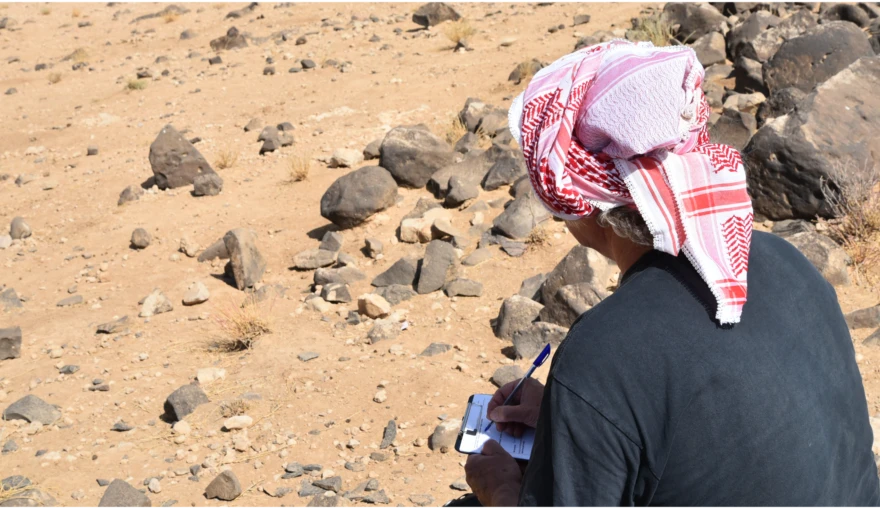
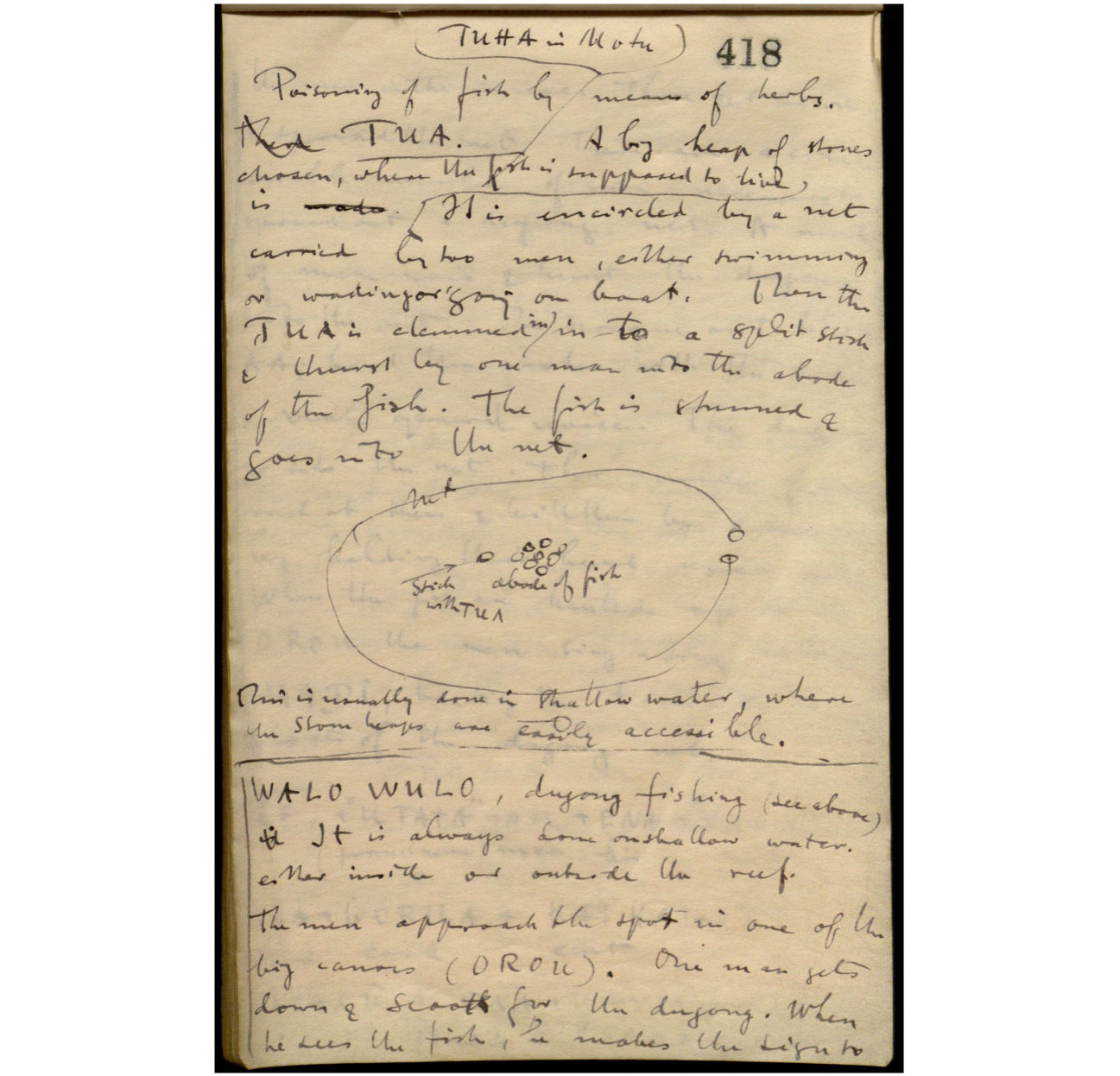
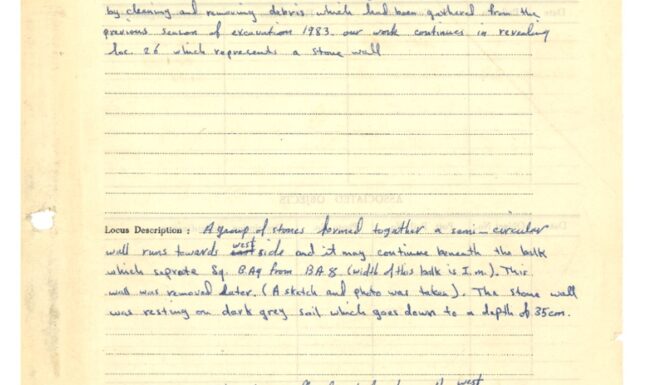
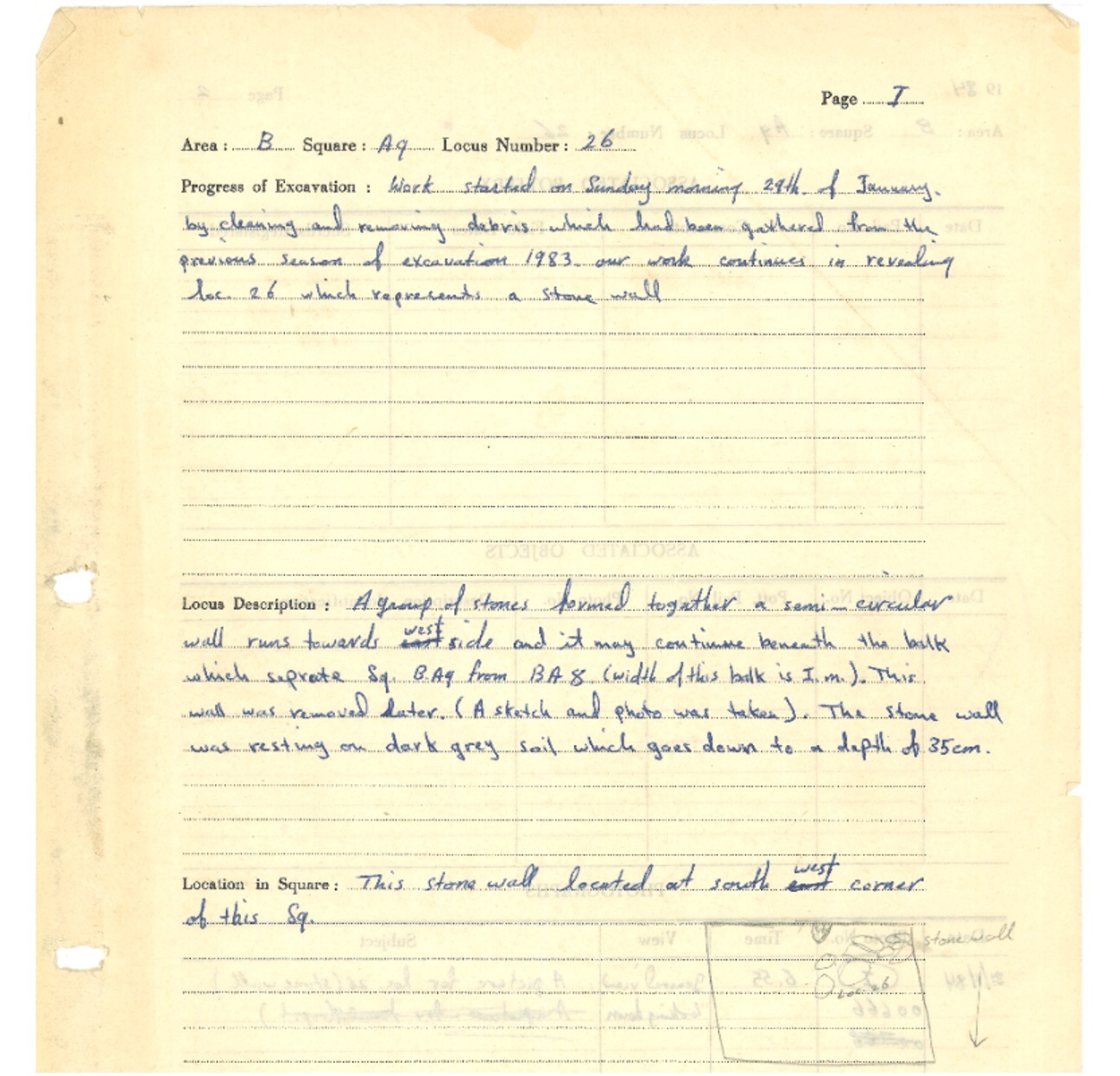
Research field notes are written data used to capture observations and research context when out on fieldwork.4 They are common in disciplines such as sociology, cultural anthropology, archaeology, linguistics, and ecology, where they form the primary data for answering research questions or the contextualisation for other research data (like interviews and observations). While they are sometimes highly structured, they tend to take the form of textual or descriptive records containing qualitative data, when relevant including sketches or drawings.5
Why publish your field notes?
There are many reasons why publishing field notes is valuable. Three main arguments are:
- For research integrity: If your field notes are your primary data, containing observations, or if they give essential context information about your other data, they are basically part of your research dataset. As such, they are needed to understand and verify the analyses and conclusions.
- Open Science: The idea behind Open Science is that research should be available to everyone, irrespective of whether they are part of an institution that has the funds to pay publishers for access. We do research to help society, we are to a large extent paid and supported by society, so we should open up our results to society.
- Reusability: Data collection through fieldwork is time consuming and can often not be repeated – think of archaeological excavation destroying its context by –literally– digging it up, disappearing endangered languages, ethnographers studying changing societies, and so on. Moreover, especially when field notes are used as primary data to record observations, it is often simply not possible for one researcher or research group to analyse and publish on all of the information they contain.
When not to publish field notes?
It is, however, not always possible to publish field notes. They may contain personal or otherwise sensitive data, and it may not be possible to completely de-identify them, or the removal of the sensitive data may render the notes no longer useful.
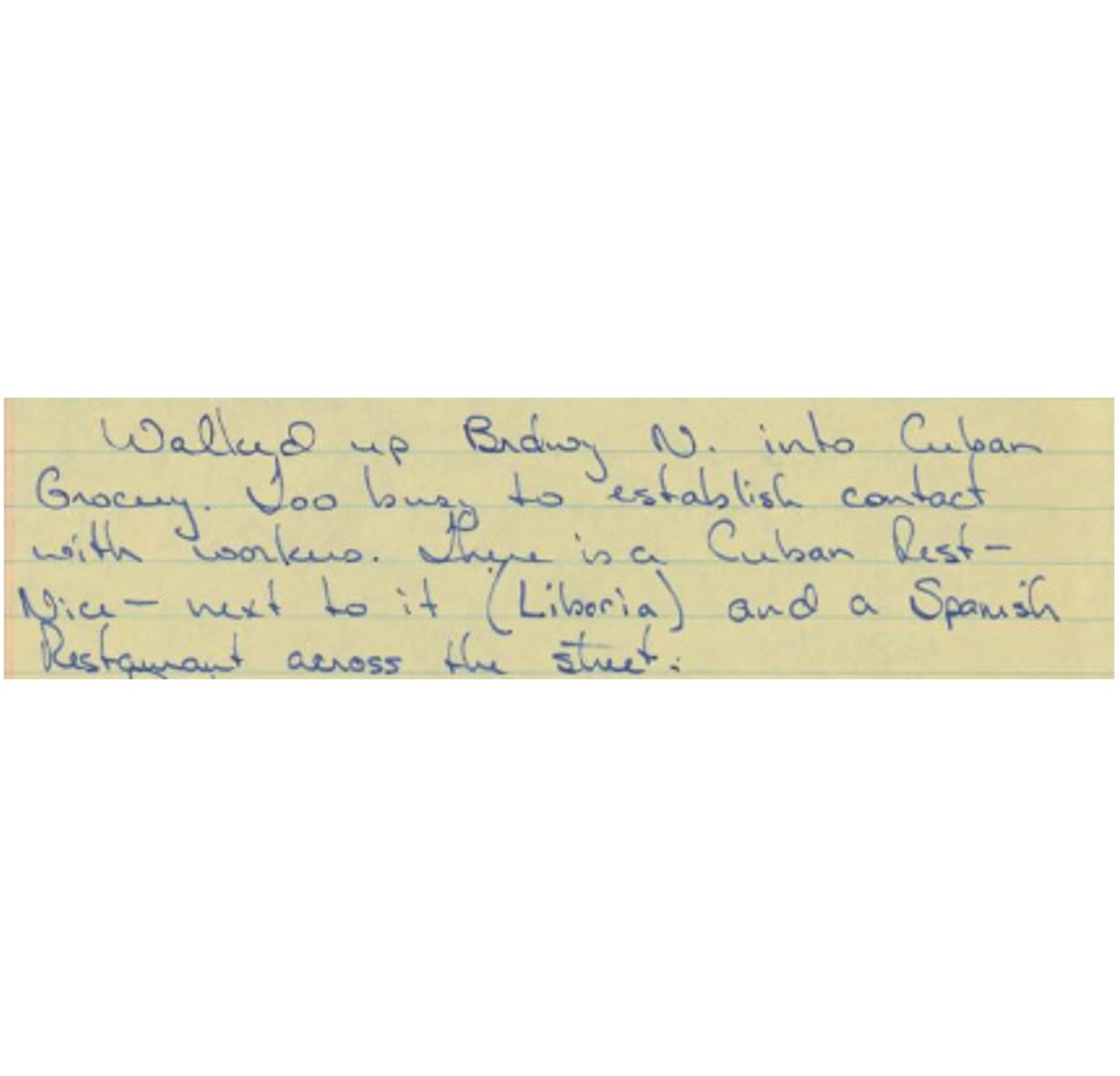
In conversations with researchers or during our workshops we sometimes hear the argument that field notes are not useful or understandable without context, while adding this context would require a lot of time.6 Nonetheless, adding context is certainly possible as shown by the work of Janneke Verheijen, who conducted anthropological fieldwork in Malawi.7 She made available her pseudonymised field notes as part of her thesis, adding context by extensive cross-referencing between the main text and (numbered) field note segments. Moreover, sharing an imperfect dataset is better than not sharing at all. If we look at historical ethnographic or archaeological field notes that have been shared without additional context, we find that indeed we cannot understand everything, but we can still understand parts and build our current research on these.
Things to take into account when deciding on sharing field notes
In my opinion, it comes down to always aiming to share field notes made as part of research, unless it is not possible based on ethical or legal grounds.
Legal aspects: When the field notes contain personal data, either informed consent should be obtained for their publication or complete de-identification (anonymisation) should be obtained. The latter is difficult and can be time consuming, while the resulting data is not always still useful. There may also be other legal aspects, like it may not be allowed to share location data of heritage sites according to local legislation.
Ethical considerations: It is important that the sharing of the field notes is not harmful for humans, animals, plants, heritage, and so on. Moreover, when deciding this, it is important to be inclusive and involve Indigenous communities (taking into the account the CARE principles), local communities, and all members of the research group.
How to decide?
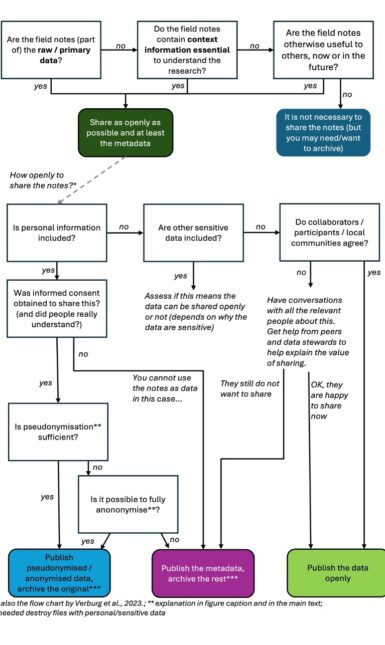
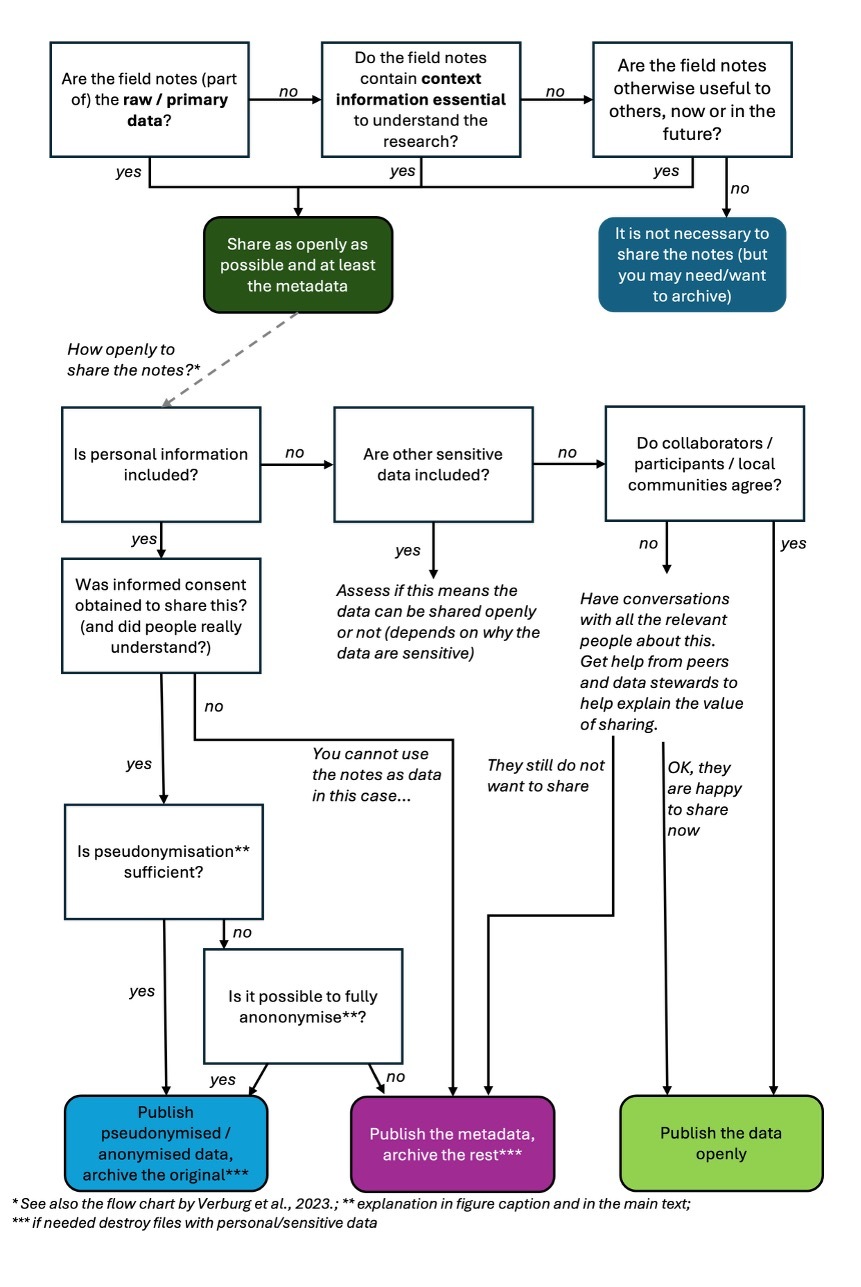
In essence, the decision comes down to asking yourself: Is it useful for others and not harmful, as well as feasible (in terms of workload) to share the field notes?
Here you can consider:
- Do the field notes contain raw or primary data on which (part of) your conclusions are based? If so, they should be shared as openly as possible, i.e. published and at least the metadata should be published openly. The rest should made available under appropriate access conditions or archived.8
- Do the field notes contain contextual information essential for understanding or replicating your research? If so, they should be shared as openly as possible, with at least the metadata published and the rest published under appropriate access conditions or archived.
- If the field notes do not contain primary data or essential contextual information, are they meaningful to others or is it possible (is time available) to make them meaningful to others?
In all cases it is important to consider if the legal and ethical preconditions have been met.
Conclusion
If you do fieldwork, it is likely that your field notes form an important part of your research data. I hope that this blog post has inspired you to share your field notes as openly as possible for others to read and reuse, so that the notes, as well as yourself, get the recognition they deserve.
Guide on sharing field notes
If you would like to know more about field notes in general, ethical and legal requirements for sharing them, and how to share them, practically speaking, you can read the full guide. The guide also contains case studies.
Link to the full guideOther resources
The ‘Beyond Personal Data’ project has produced three sets of training materials & guides on publishing and otherwise sharing hard-to-share data in the social sciences and humanities:
- Sharing field notes training materials
- Ethics of sharing fieldwork data and the CARE principles guide and training materials
- Hard-to-share data in the social sciences and humanities and using the Secure ANalysis Environment (SANE) guide and training materials
Notes and references
- Personal data is information that can be directly or indirectly used to identify a living person.
- At least in the EU and UK, where the General Data Protection Regulation applies (https://gdpr.eu/ and https://www.gov.uk/data-protection). There are other legal grounds for sharing personal data beyond informed consent, see https://gdpr.eu/article-6-how-to-process-personal-data-legally/.
- The project ‘Beyond personal data: RDNL training on hard-to-share data for SSH early-career researchers’ was set up by project partners SURF, DANS, the Erasmus University International Institute of Social Studies, the Promovendi Network Netherlands, ODISSEI, and Leiden University Libraries. It was funded by the NWO TDCC-SSH Bottleneck fund and ran for the duration of 2025. The project focused both on providing training plus related training materials and on producing guides.
- This blog uses excerpts, sometimes literally, from the guidebook ‘Sharing field notes’ (Flohr et al. 2026).
- See Emerson, R.M., Fretz, R.I. and Shaw, L.L. (2011) Writing ethnographic fieldnotes.
2nd ed. Chicago: The University of Chicago Press; Jovanović, T. (2022) e-ERIM, Field diary and field notes.
https://e-erim.ief.hr/pojam/te... - See also Emerson et al. 2011.
- Verheijen, J. and van der Geest, S. (2020) ‘Co-production, friendship, and transparency in
anthropological fieldnotes’, in C. Burkholder and J. Thompson (eds), Fieldnotes in qualitative
education and social science research. Routledge. https://doi.org/10.4324/978042... ; Verheijen, J.P.E. (2013) Balancing men, morals and money: women’s agency between
HIV and security in a Malawi village. African Studies Centre.
https://hdl.handle.net/1887/21.... - Where publishing the field notes openly does not mean it is not a good idea to also archive them somewhere as well.
Acknowledgements
This blog post was reviewed by Ben Companjen and Femmy Admiraal. The Beyond personal data project was funded by the NWO through the TDCC-SSH with file number ICT.DCC.001.002. Many thanks go to the guide contributors, project members, and other workshop participants.
FAIA HCC: Human-Created Content. This content was created exclusively by humans without the use of generative AI systems. Declared under the FAIA framework (faia.io).